

Sustainability Focused Programs
Empowering the Next Generation of Climate Leaders
At Canadian University Dubai (CUD), we recognize that education is the most powerful tool for climate action. Our academic portfolio is strategically designed to integrate environmental stewardship, resource efficiency, and sustainable innovation into the core of our curriculum.
All programs listed below are fully accredited by the UAE Ministry of Education -- Higher Education Affairs, ensuring that every credit earned is officially recognized both locally and internationally. These programs lead to the award of specialized qualifications that explicitly address the global challenges of climate science, renewable energy, and the circular economy. Through a blend of theoretical rigor and practical application, CUD prepares students to lead the transition toward a sustainable and resilient future.
Full details of the programs can be found here:
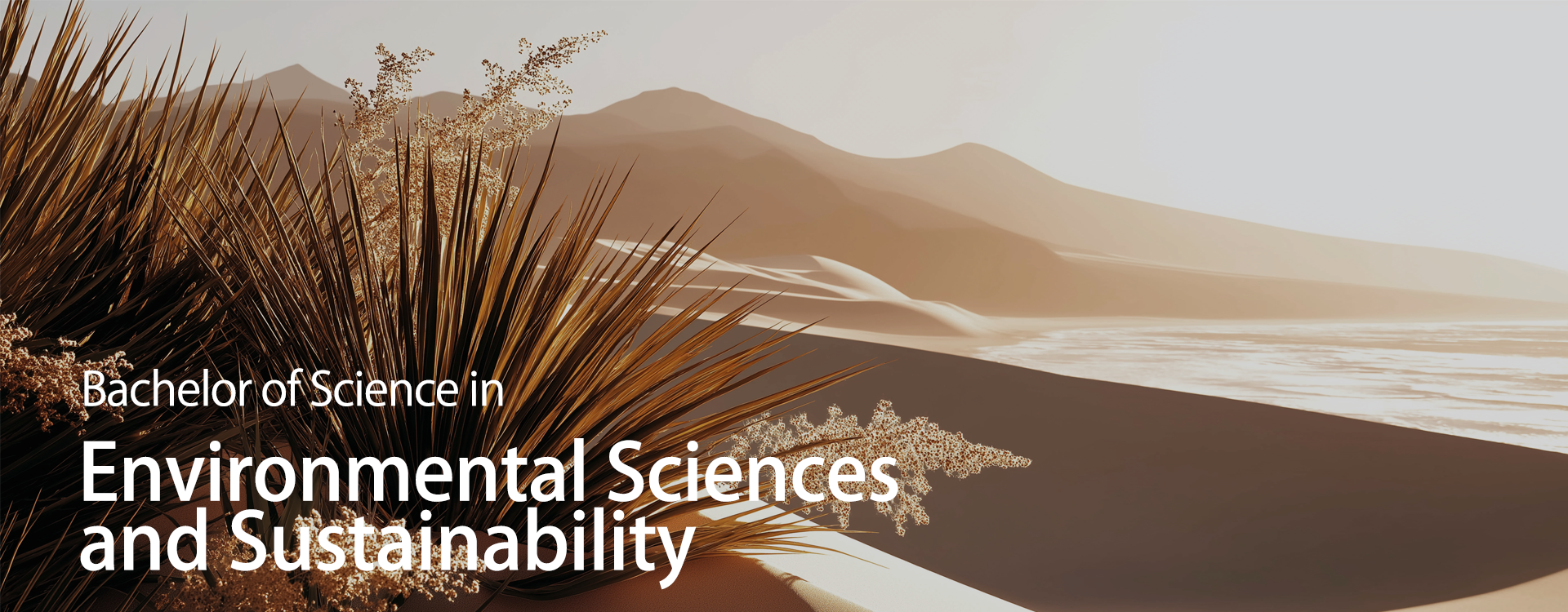
Bachelor of Science in Environmental Sciences and Sustainability (BScESS)
Qualification Level: Undergraduate Degree (BSc)
Sustainability Focus
This interdisciplinary program integrates core knowledge in environmental science, chemistry, biology, statistics, hydrology, environmental health, GIS, environmental economics, and policy. It prepares graduates to analyze environmental processes and human–environment interactions, and to support evidence-based decision-making through environmental monitoring, impact assessment, resource management, pollution control, and natural hazards analysis.
-
Core Course Highlight: ESS 110 — Principles of Sustainability
- Description: Provides the foundational framework for sustainability science, exploring the interconnections between environmental, social, and economic systems and the principles of sustainable development.
- Sustainability Link: Grounds students in the core "Environmental Sustainability" concepts that underpin all subsequent environmental science coursework.
-
Core Course Highlight: ESS 321 — Environmental Impact Assessment
- Description: Students learn to evaluate the environmental consequences of proposed projects and policies, using systematic assessment frameworks to inform sustainable planning and regulatory compliance.
- Sustainability Link: Equips students with the technical evidence-based tools required to mitigate environmental degradation and support responsible development.
-
Core Course Highlight: ESS 310 — Geographic Information Systems
- Description: Focuses on the use of spatial data, remote sensing, and GIS technologies to map, monitor, and manage environmental systems and natural resources.
- Sustainability Link: Provides the "Climate Science" and spatial analysis skills needed to track environmental change and support data-driven sustainability decisions.
-
Core Course Highlight: ESS 420 — Environmental Law, Policy and Governance
- Description: Examines the legal and institutional frameworks governing environmental protection, natural resource use, and climate policy at national and international levels.
- Sustainability Link: Addresses "Environmental Sustainability" through the study of governance mechanisms that translate climate science into enforceable policy solutions.
-
Concentration Course Highlight: CAM 410 — Climate Science and Modelling
- Description: Part of the Climate Change Mitigation and Adaptation pathway, this course introduces students to the scientific principles and computational models used to project climate change and evaluate mitigation scenarios.
- Sustainability Link: Directly satisfies the "Climate Science" prompt by linking climate modelling to the design of adaptation and carbon-reduction strategies.
Full details of the programs can be found here:
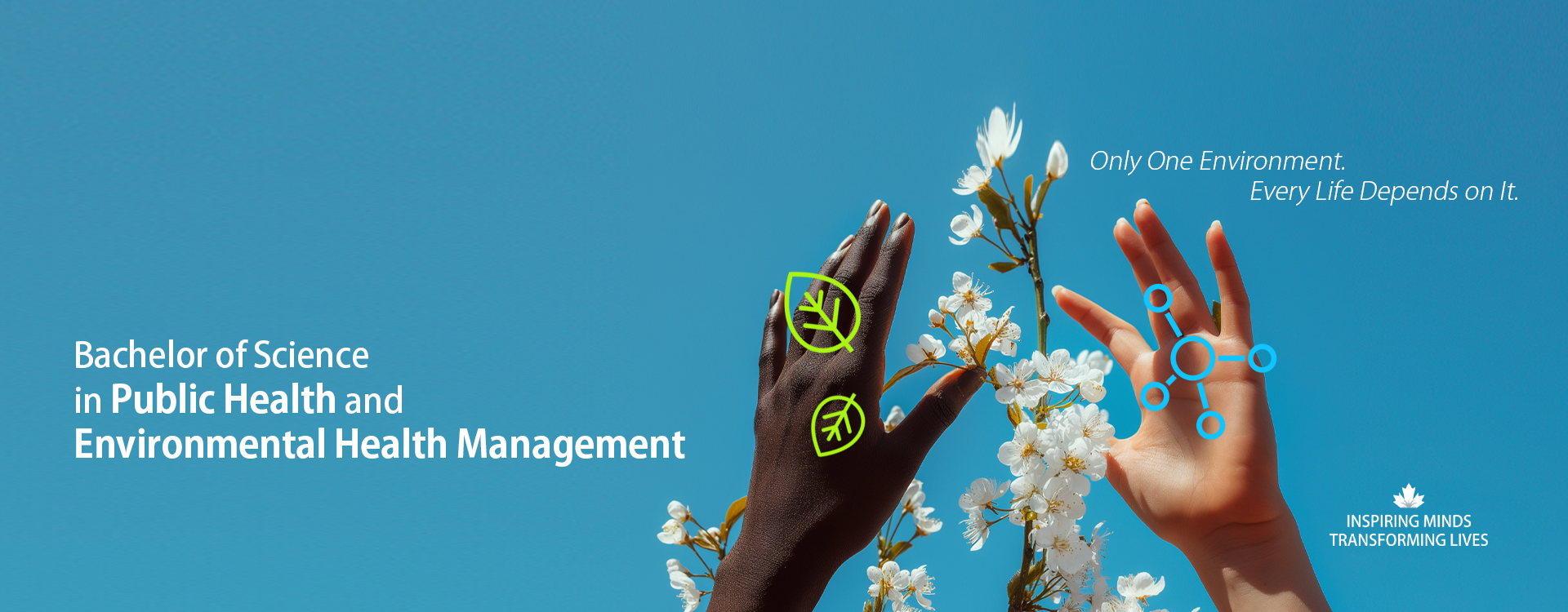
Bachelor of Science in Public Health and Environmental Health Management
Qualification Level: Undergraduate Degree (BSc)
Sustainability Focus
This program addresses the intersection of human health and the natural environment. It focuses on analyzing, evaluating, and controlling environmental factors—such as air quality, water safety, and waste management—to mitigate the impacts of climate change and environmental degradation on public health.
-
Core Course Highlight: ENV 424 — Impacts of Climate Change Policy on Environmental Management
- Description: This advanced course explores the specific policy frameworks designed to address global climate change and their practical implementation within environmental management systems.
- Sustainability Link: It provides students with the critical tools to understand how climate policy influences environmental protection.
-
Core Course Highlight: ENV 326 — Indoor and Outdoor Air Pollution
- Description: An in-depth study of the sources, chemistry, and transport of air pollutants, as well as their impacts on ecosystems and human respiratory health.
- Sustainability Link: By teaching students to monitor and mitigate carbon-based and chemical emissions, this course provides technical evidence for environmental sustainability education.
-
Core Course Highlight: ENV 321 — Management of Domestic and Hazardous Wastes
- Description: This course covers the lifecycle of waste products, emphasizing sustainable disposal methods, recycling, and the reduction of hazardous environmental contamination.
- Sustainability Link: It aligns with "Environmental Sustainability" by focusing on waste reduction and the protection of soil and water resources from toxic exposure.
-
Core Course Highlight: ENV 413 — Marine Pollution
- Description: A specialized look at the degradation of marine ecosystems due to human activity, chemical runoff, and plastic waste.
- Sustainability Link: Addresses the protection of biodiversity and aquatic environments, a key pillar of environmental science.
-
Core Course Highlight: ENV 309 — Impacts of Earth Resources and Natural Hazards on the Environment
- Description: This elective examines how the extraction of natural resources and the occurrence of natural disasters (often exacerbated by climate change) affect environmental stability.
- Sustainability Link: Directly links geological and earth science with environmental risk management and sustainability.

Full details of the programs can be found here:
Bachelor of Science in Power & Renewable Energy Engineering
Qualification Level: Undergraduate Degree (BSc)
Sustainability Focus
This program is specifically designed to train the next generation of engineers to lead the global clean energy transition. It aligns with the UAE's Net Zero 2050 vision and the Dubai Clean Energy Strategy 2050, focusing on the technical design, optimization, and implementation of carbon-neutral power systems.
-
Core Course Highlight: PRE 362 — Solar Energy
- Description: An in-depth study of photovoltaic systems, solar thermal energy, and the engineering principles required to harness solar radiation for large-scale power generation.
- Sustainability Link: Directly addresses the "Environmental Sustainability" prompt by providing technical expertise in one of the primary alternatives to fossil-fuel-based energy.
-
Core Course Highlight: PRE 471 — Wind Energy
- Description: This course covers the aerodynamics of wind turbines, site assessment, and the integration of wind-generated electricity into existing power grids.
- Sustainability Link: Provides evidence of education specifically targeting renewable resource management and climate-neutral technology.
-
Core Course Highlight: DES 320 — Design for Sustainability
- Description: A multidisciplinary course that teaches students how to integrate environmental considerations into the engineering design process, focusing on life-cycle analysis and resource efficiency.
- Sustainability Link: Broader principles of environmental sustainability within a technical framework.
-
Core Course Highlight: PRE 481 — Smart Grids
- Description: Focuses on the modernization of the electrical grid using digital technology to improve efficiency, reduce energy waste, and facilitate the reliable integration of renewable energy sources.
- Sustainability Link: Teaches students how to manage "Climate Science" challenges through infrastructure innovation and demand-side energy management.
-
Core Course Highlight: PRE 473 — Energy Conversion and Storage
- Description: Examines the methods of converting renewable energy into various forms and the critical role of battery and thermal storage in stabilizing green energy supplies.
- Sustainability Link: Essential for a sustainable energy future, this course addresses the intermittency of renewables—a core challenge in climate science.
Full details of the programs can be found here:
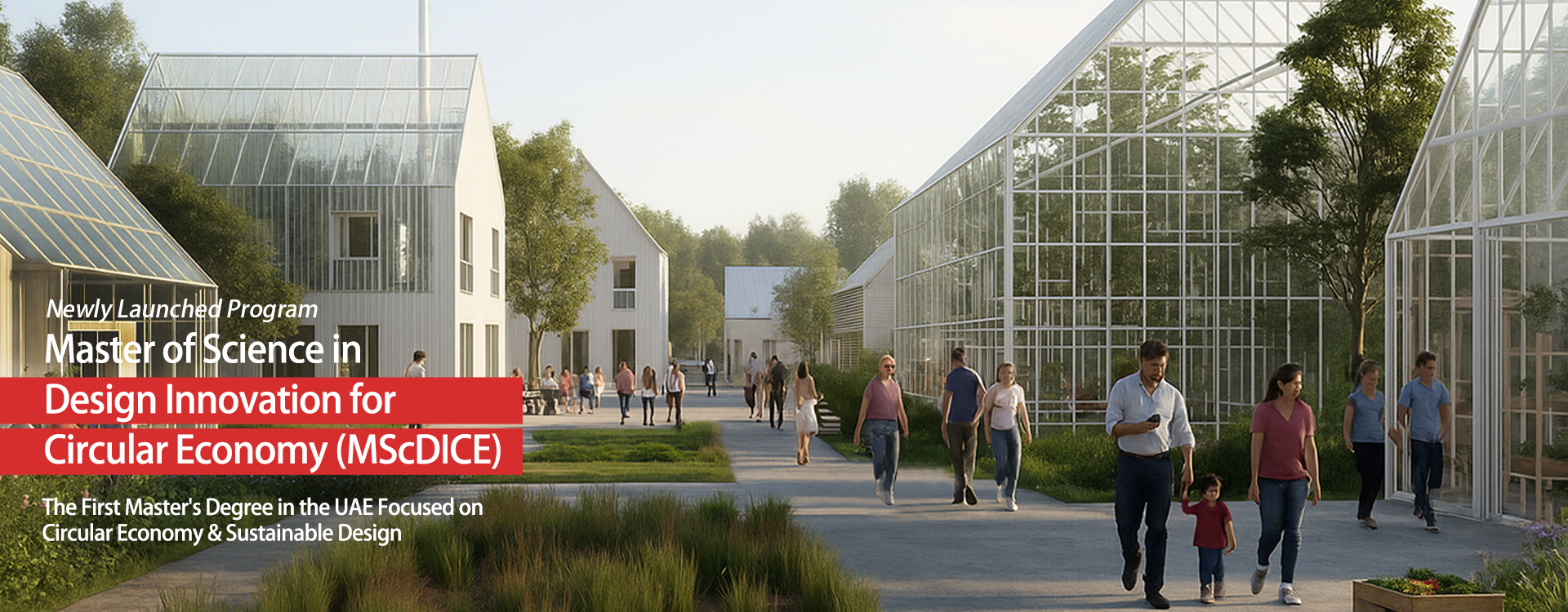
Master of Science in Design Innovation for Circular Economy (MScDICE)
Qualification Level: Master's Degree (MSc)
Sustainability Focus
This advanced degree focuses on the systemic transition from linear "take-make-waste" models to regenerative circular economies. It treats the climate crisis as a design challenge, equipping leaders to rethink products, urban systems, and policies to restore ecosystem balance and drive carbon neutrality.
-
Core Course Highlight: DCE 611 — Design-Out Climate
- Description: A foundational course exploring how design decisions contribute to or mitigate the climate crisis. It frames environmental degradation as a "design by-product" that can be engineered out of existence.
- Sustainability Link: This course satisfies the "Climate Science" prompt by directly linking human-led activity (design) to global climate impacts and mitigation strategies.
-
Core Course Highlight: DCE 612 — Principles of Circular Economy
- Description: Provides the theoretical and practical framework for circularity, focusing on resource regeneration, extending product lifecycles, and designing out waste and pollution.
- Sustainability Link: Explicitly teaches "Environmental Sustainability" through the lens of resource efficiency and sustainable industrial systems.
-
Core Course Highlight: DCE 621 — Lifecycle Assessment and Circular Metrics
- Description: Students learn to use data-driven methodologies to calculate the environmental footprint of products and systems across their entire lifespan.
- Sustainability Link: Provides the technical "evidence" required for sustainability reporting and environmental impact quantification.
-
Core Course Highlight: DCE 622 — Regenerative Buildings and Cities
- Description: Focuses on the built environment, exploring how urban design can move beyond "low impact" to actually restoring and regenerating local ecosystems.
- Sustainability Link: Addresses large-scale environmental sustainability within the context of rapid urbanization and climate adaptation.
-
Elective Course Highlight: DCE 626 — Impacts of Climate Change Policy on Environmental Management
- Description: Analyzes how international and local climate policies (such as the UAE Net Zero 2050) dictate the management of natural resources and industrial output.
- Sustainability Link: Study of climate science and its resulting policy solutions.
Full details of the programs can be found here:
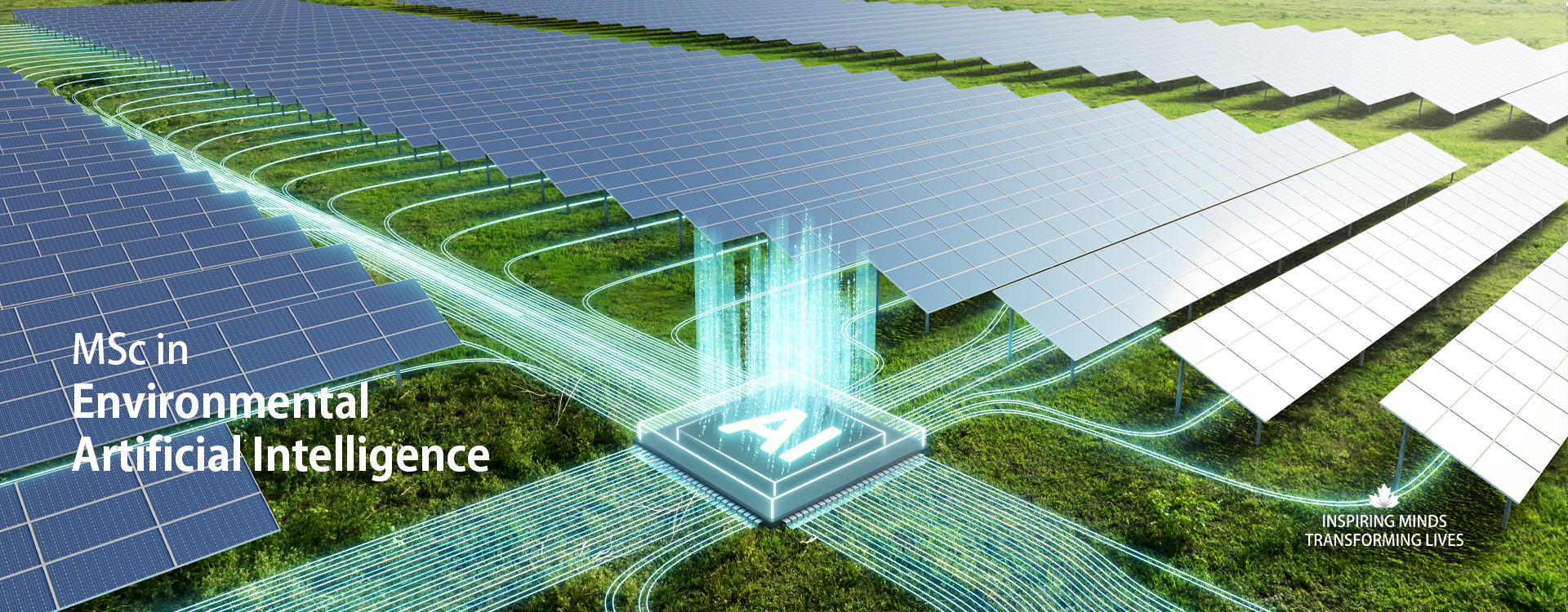
Master of Science in Environmental Artificial Intelligence (MScEAI)
Qualification Level: Master's Degree (MSc)
Sustainability Focus
This interdisciplinary graduate program integrates advanced artificial intelligence techniques with environmental science to address global sustainability challenges. It equips students with expertise in machine learning, data analytics, remote sensing, and ecological modelling to analyze complex environmental systems, with practical applications in climate change mitigation, biodiversity conservation, renewable energy optimization, and smart resource management.
-
Core Course Highlight: MEI 601 — AI for Climate Science and Environmental Systems
- Description: Explores how artificial intelligence models are applied to climate data, environmental monitoring, and the simulation of complex earth systems.
- Sustainability Link: Directly addresses the "Climate Science" prompt by using AI to improve climate prediction and support mitigation strategies.
-
Core Course Highlight: MEI 603 — Deep Learning for Earth Observation
- Description: Teaches students to apply deep learning techniques to satellite imagery and remote sensing data for land-use, ecosystem, and natural resource analysis.
- Sustainability Link: Provides the technical evidence required for "Environmental Sustainability" monitoring, from deforestation tracking to biodiversity assessment.
-
Core Course Highlight: MEI 605 — Geospatial Artificial Intelligence
- Description: Combines GIS, spatial statistics, and machine learning to build intelligent models of environmental and urban systems across geographic scales.
- Sustainability Link: Enables spatial data-driven decision-making for climate adaptation and sustainable resource planning.
-
Core Course Highlight: MEI 608 — Climate Risk Analytics
- Description: Introduces quantitative methods for assessing climate-related risks, vulnerability, and exposure in support of resilient infrastructure and ESG reporting.
- Sustainability Link: Links "Climate Science" to concrete risk management frameworks that guide sustainable investment and policy decisions.
-
Capstone Course Highlight: MEI 621 — Master's Thesis
- Description: A research-driven capstone conducted in partnership with government bodies and industry leaders, applying AI solutions to real-world environmental problems.
- Sustainability Link: Delivers tangible, real-world environmental impact by translating research into actionable sustainability outcomes aligned with UAE initiatives such as Net Zero 2050.
Programs in Sustainability