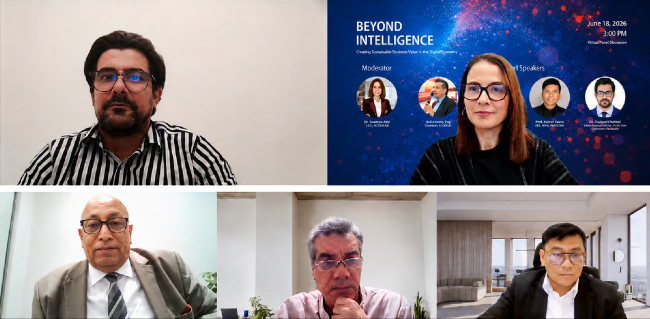
June 18, 2026, Dubai, United Arab Emirates (UAE): Canadian University Dubai's (CUD) School of Management recently hosted Beyond Intelligence: Creating Sustainable Business Value in the Digital Economy, an interdisciplinary expert panel discussion exploring how organizations can create long-term value and competitive advantage in an increasingly digital, data-driven, and globally interconnected business environment.
Moderated by Dr. Soumaya Askri, Assistant Professor at the School of Management, the panel featured fellow School of Management faculty members Dr. Farooq Haq, Professor of Marketing; Dr. Mohamed Noureldin Ahmed Abdelhakim, Professor of Business and Informatics; Dr. Rommel Sergio, Professor of Management; and Dr. Zakariya Chabani, Associate Professor.
The panel was organized in response to a growing recognition that while organizations continue to invest heavily in technologies such as artificial intelligence, analytics, automation, and cloud computing, many still face challenges in translating these investments into sustainable business value. Rather than focusing solely on technology adoption, the discussion explored how organizations can create meaningful and lasting impact through strategic leadership, customer-centricity, organizational transformation, and global competitiveness.
A recurring theme throughout the discussion was that technology alone does not create value. Panelists emphasized that sustainable success depends on how organizations align digital capabilities with strategy, leadership, customer needs, and organizational culture. Discussions highlighted how organizations that successfully combine technology, people, and strategic direction are better positioned to create long-term value and remain competitive in rapidly evolving markets.
The panel also examined how organizations can leverage digital tools and data-driven insights to strengthen customer engagement and decision-making. Key discussion points included the growing importance of personalization, convenience, transparency, and seamless customer experiences, as well as the role of artificial intelligence and analytics in supporting innovation and operational effectiveness.
The discussion referenced organizations such as Amazon and Netflix as examples of how artificial intelligence and data-driven insights can be used to personalize customer experiences, improve decision-making, and create competitive advantage. The panel also highlighted the UAE's ongoing digital transformation initiatives as examples of how technology, leadership, and skills development can work together to drive innovation and service excellence.
Strategic leadership emerged as another critical factor in successful transformation. Panelists discussed the importance of establishing a clear vision, fostering innovation, investing in employee development, and building organizational cultures that embrace adaptability and continuous learning. The discussion reinforced that leadership plays a vital role in ensuring that digital transformation efforts support broader organizational goals and deliver sustainable outcomes.
The interdisciplinary nature of the discussion provided participants with a holistic perspective on sustainable value creation. Insights from marketing, e-business, management, leadership, and international business demonstrated that long-term success depends on balancing technological capability with strategic thinking, human-centred leadership, and customer focus.
Looking to the future, panelists emphasized that the next generation of business leaders will require both technological expertise and human-centred capabilities to thrive in increasingly complex and interconnected environments. Students and young professionals are encouraged to develop digital literacy, data analytics, communication, critical thinking, adaptability, and problem-solving skills alongside technical knowledge.
Reflecting on the discussion, Dr. Soumaya Askri noted:
"Sustainable business value is not created by technology alone. It is created when innovation is guided by accountability, shaped by ethical leadership, strengthened through inclusion and respect, and empowered by people who are adaptable, resilient, and committed to excellence. Technology may accelerate progress, but people give it purpose."
The panel concluded with a clear message: while technology continues to reshape industries and create new opportunities, sustainable business value is ultimately achieved when organizations align innovation with strategy, leadership, customer needs, and long-term organizational goals.