Program Overview
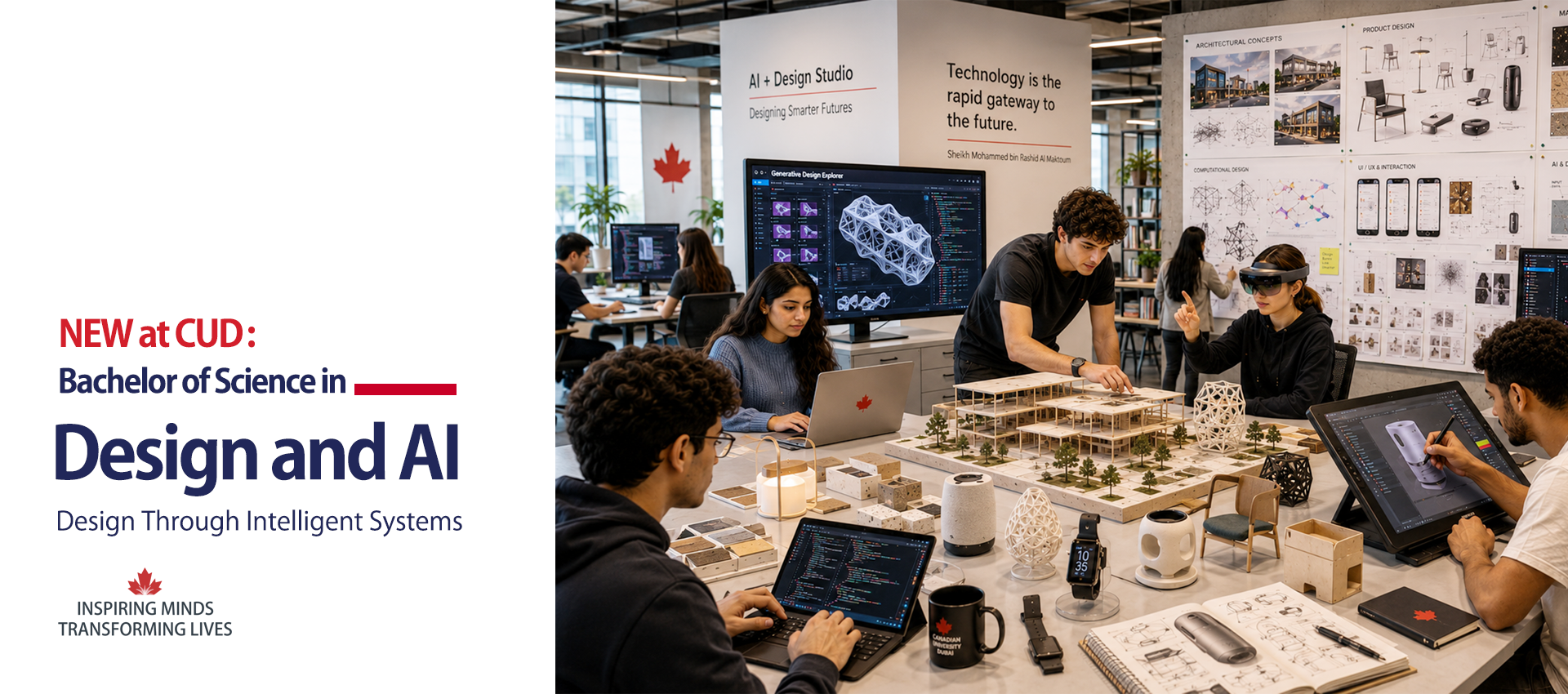
The Bachelor of Science in Design and Artificial Intelligence (BScDAI) is an interdisciplinary program that brings together design, artificial intelligence, and digital technologies. The program combines studio-based learning with courses in design, computing, mathematics, and emerging technologies to prepare students for creative and technology-supported design practice across different fields. Innovation and entrepreneurship, sustainability, research and critical thinking, digital fluency, and community engagement are integrated throughout the curriculum and explored through studios, computing courses, entrepreneurship courses, ethics, visualization, and AI applications.
Benefits
The curriculum encourages students to think systemically, work collaboratively, and apply computational and AI-based approaches within design processes. Through progressive studio experiences and technical coursework, students build skills in visualization, interaction design, prototyping, and data-informed design development. The program also highlights the ethical, social, and environmental responsibilities connected to the use of emerging technologies in design practice. The program promotes hands-on and interdisciplinary learning through studio projects, internships, and capstone experiences that connect design methods with contemporary digital and intelligent technologies.
Career Opportunities
Graduates of the BScDAI program will be prepared to pursue contemporary design careers across the creative, technological, and built environment industries. Rather than replacing traditional design professions, the program redefines them by equipping graduates with the knowledge and skills to integrate artificial intelligence, computational methods, and data-driven decision-making into every stage of the design process.
Whether designing spaces, products, or services, graduates will be able to work alongside intelligent systems to generate innovative solutions, optimize design performance, enhance user experiences, and create adaptive environments. This unique combination of design thinking and AI competencies positions graduates to lead the next generation of professional practice, where human creativity and computational intelligence increasingly work together.
Career opportunities include:
- AI-Enabled Architectural Designer
- AI-Enabled Interior Designer
- AI-Enabled Product Designer
- AI-Enabled Service Designer
- Computational Designer
- UX/UI and Human-Computer Interaction (HCI) Designer
- Digital Experience Designer
- Generative Design Specialist
- Digital Twin Designer
- Smart Environment Designer
- Creative Technologist
- Design Technology Consultant
- AI Innovation Consultant
- Design Researcher
- Design Project Manager
The Ministry of Higher Education and Scientific Research (MoHESR) of the UAE awarded the program accreditation on June 25, 2026.
This program is accredited by the Commission for Academic Accreditation (CAA), Ministry of Higher Education and Scientific Research (MoHESR).
Graduates of the Bachelor of Science in Design and Artificial Intelligence program, within a few years of graduation, will be able to:
Goal 1. Equip students with foundational and advanced knowledge in design, computer science, artificial intelligence, and human-computer interaction to address contemporary design challenges.
Goal 2. Foster an interdisciplinary mindset that synthesizes creative design thinking with computational intelligence, enabling the co-evolution of form, data, and behavior.
Goal 3. Cultivate ethical and critical awareness of how AI and machine learning technologies shape human experiences, decision-making, and the built environment.
Goal 4. Enable students to design through AI by integrating data-driven, generative, and adaptive computational processes into the conception, development, and evaluation of design solutions.
Goal 5. Promote responsible design practices that critically engage with the socio-technical implications of AI as an active agent in shaping human environments.
Goal 6. Empower students to engage in entrepreneurial, speculative, and future-oriented design initiatives that leverage the potential of emerging technologies.
Upon successful completion of the BScDAI program, graduates will be able to:
PLO 1. Demonstrate advanced knowledge of design, artificial intelligence, and human-computer interaction to frame and solve complex, real-world problems.
PLO 2. Apply advanced and innovative AI techniques and data-driven methods to support, inform, and optimize design processes and decision-making.
PLO 3. Develop human-centered, context-aware, and sustainable design solutions across spatial, product, and service domains using computational and algorithmic thinking.
PLO 4. Apply programming, computational tools, and digital fabrication techniques to prototype interactive, responsive, and innovative intelligent systems.
PLO 5. Critically evaluate and apply AI technologies with ethical, social, cultural, and environmental responsibility in professional and societal contexts.
PLO 6. Design adaptive digital-physical environments and systems that respond to user needs through data-driven and real-time interactions.
PLO 7. Collaborate effectively in multidisciplinary teams and communicate ideas and outcomes through visual, verbal, and data-driven formats to diverse stakeholders.
PLO 8. Develop AI-enabled design solutions for emerging and future contexts through speculative, entrepreneurial thinking, leadership, and lifelong learning.
The BScDAI degree shall be awarded to a student upon completing the following requirements:
- The student enrolled in the program must have passed 128 credit hours.
- The student must achieve a CGPA of not less than 2.0 on a scale of 4.0 points.
- The student must have earned at least 50% of credits at CUD.
- Internship and Capstone Project work must be completed while enrolled at CUD.
Program Structure
| Requirements | Compulsory Credit Hours |
|---|---|
| I. Core Courses | 86 Cr. Hrs. |
| II. Electives | 12 Cr. Hrs. |
| III. Practical experience and Projects | 9 Cr. Hrs. |
| IV. University Requirement and General Education | 21 Cr. Hrs. |
| Total | 128 Cr. Hrs. |
| Course | Course Title | Pre/Co-requisite | Cr. Hrs. |
|---|---|---|---|
| Mathematics, Statistics, and Computer Science Courses | 18 | ||
| MTH 112 | Calculus 1 | None | 3 |
| MTH 114 | Linear Algebra | MTH 112 | 3 |
| MTH 120 | Discrete Mathematics | None | 3 |
| MTH 130 | Probability and Statistics | MTH 112 | 3 |
| SWS 110 | Programming 1 | None | 3 |
| SWS 111 | Programming 2 | SWS 110 | 3 |
| Design Courses | 23 | ||
| DES 101 | Studio 1- Introduction to Design | DES 110 and DES 113 | 4 |
| DES 102 | Studio 2- Design and the Human | DES 101, DES 110, DES 113, DES 120 | 4 |
| DES 110 | Design Theory | DES 101 and DES 113 | 3 |
| DES 120 | Human Factors | DES 102 | 3 |
| DES 113 | Drafting and Modeling | DES 101 and DES 110 | 3 |
| DES 214 | Computer Aided Design | DES 113 | 3 |
| DES 381 | Artificial Intelligence for Design Applications | DES 214 | 3 |
| Design and Artificial Intelligence Courses | 30 | ||
| DAI 202 | Product Design Studio | DES 102, BAI 201 and DES 214 | 6 |
| DAI 223 | Design History in the Age of Artificial Intelligence | None | 3 |
| DAI 301 | Service Design Studio | DAI 202 | 6 |
| DAI 302 | Spatial Design Studio | DAI 301 | 6 |
| DAI 311 | Human Computer Interaction and AI | BAI 201 and DES 214 | 3 |
| DAI 312 | Artificial Intelligence and Computer Vision | DES 381 and BAI 301 | 3 |
| DAI 402 | Ethics, Society, and Futures of Artificial Intelligence | BAI 302 | 3 |
| Artificial Intelligence Courses | 15 | ||
| BAI 201 | Introduction to Artificial Intelligence | SWS 110 or BCS 101 and MTH 112 | 3 |
| BAI 301 | Introduction to Machine Learning | BAI 201 and MTH 130 | 3 |
| BAI 302 | Generative AI | BAI 201 | 3 |
| BAI 304 | Deep Neural Networks | BAI 201 and MTH 114 | 3 |
| BAI 308 | Introduction to Natural Language Processing | BAI 301 | 3 |
| Course | Course Title | Pre/Co-requisite | Cr. Hrs. |
|---|---|---|---|
| Elective Courses (12 Credits): Students are required to select four courses from the following courses. | |||
| BAI 204 | AI Project Management | BAI 201 | 3 |
| DES 231 | Sustainability of Buildings | DES 102 | 3 |
| MCM 250 | Digital Imaging | None | 3 |
| IDF 309 | Sustainable Design | None | 3 |
| DAI 321 | Designing Immersive Environments | DES 214 | 3 |
| DES 372 | Graphic Design and Portfolio for Architects and Interior Designers | DES 214 | 3 |
| DES 382 | Data Analytics in the Built Environment | MTH 112 and DES 214 | 3 |
| BCS 401 | Ethics for Computing Professionals | None | 3 |
| DES 440 | Visualization | DES 214 | 3 |
| RTA 402 | Social Media | None | 3 |
| DAI 403 | Digital Twins, Agents, and Smart Ecosystems | DAI 311 and BAI 301 | 3 |
| DAI 404 | Agentic AI and Multi-Agent Systems for Design | BAI 308 | 3 |
| Course Code | Course Title | Prerequisite | Credit Hours | |
|---|---|---|---|---|
|
Practical Experience and Project |
9 |
|||
| DAI | 401 | Capstone Project
Note: DAI 401 Capstone Project is a 6-credit capstone course delivered over Semesters 7 and 8. Students register for the course in Semester 7 only, and the work continues into Semester 8 without additional registration or credit. |
DAI 302 | 6 |
| DAI | 400 | Internship in Design and Artificial Intelligence
Note: Students may enrol in DAI 400 (Internship in Design and Artificial Intelligence) and start their internship during the summer semester of Semester 7, provided they have successfully completed the prerequisite requirements: completion of 90 Credit Hours and maintaining a CGPA ≥ 2.0. The internship may also be split across two summer semesters, subject to departmental approval. |
Completion of 90 Cr. Hrs. and CGPA >= 2 | 3 |
| Course Code | Course Title | Prerequisite | Credit Hours | |
|---|---|---|---|---|
|
University Requirements Courses |
21 |
|||
|
Compulsory Courses |
18 |
|||
| LNG | 171 | English I | None | 3 |
| LNG | 172 | English II | LNG 171 | 3 |
| ENT | 141 | Fundamentals of Innovation and Entrepreneurship 1 | None | 2 |
| ENT | 142 | Fundamentals of Innovation and Entrepreneurship 2 | ENT 141 | 1 |
| GED | 190 | Emirati Studies | None | 3 |
| GED | 255 | Critical Thinking and Problem Solving | LNG 172 | 3 |
| ENT | 241 | Entrepreneurship 1 | ENT 142 | 2 |
| ENT | 242 | Entrepreneurship 2 | ENT 241 | 1 |
|
Humanities Elective Courses (03 Credits): Students are required to select one course from the following courses |
3 |
|||
| GED | 110 | Modern Art Appreciation | None | 3 |
| GED | 196 | Communication Skills in Arabic | None | 3 |
| GED | 205 | Psychology in Everyday Life | LNG 172 | 3 |
| GED | 272 | Fundamentals of Public Speaking | LNG 172 | 3 |
| GED | 324 | Ethical Reasoning for Today’s World | LNG 172 | 3 |
* Co-requisites are underlined.
NOTE: Ethical awareness and responsible AI practices will be introduced throughout AI courses, including BAI 201 Introduction to Artificial Intelligence, BAI 301 Introduction to Machine Learning, and BAI 302 Generative AI. Students will progressively develop a deeper understanding of the ethical, social, and societal implications of AI technologies, which will be further explored in depth in DAI 402 Ethics, Society, and Futures of Artificial Intelligence through critical discussion and analysis of emerging AI challenges and future impacts.