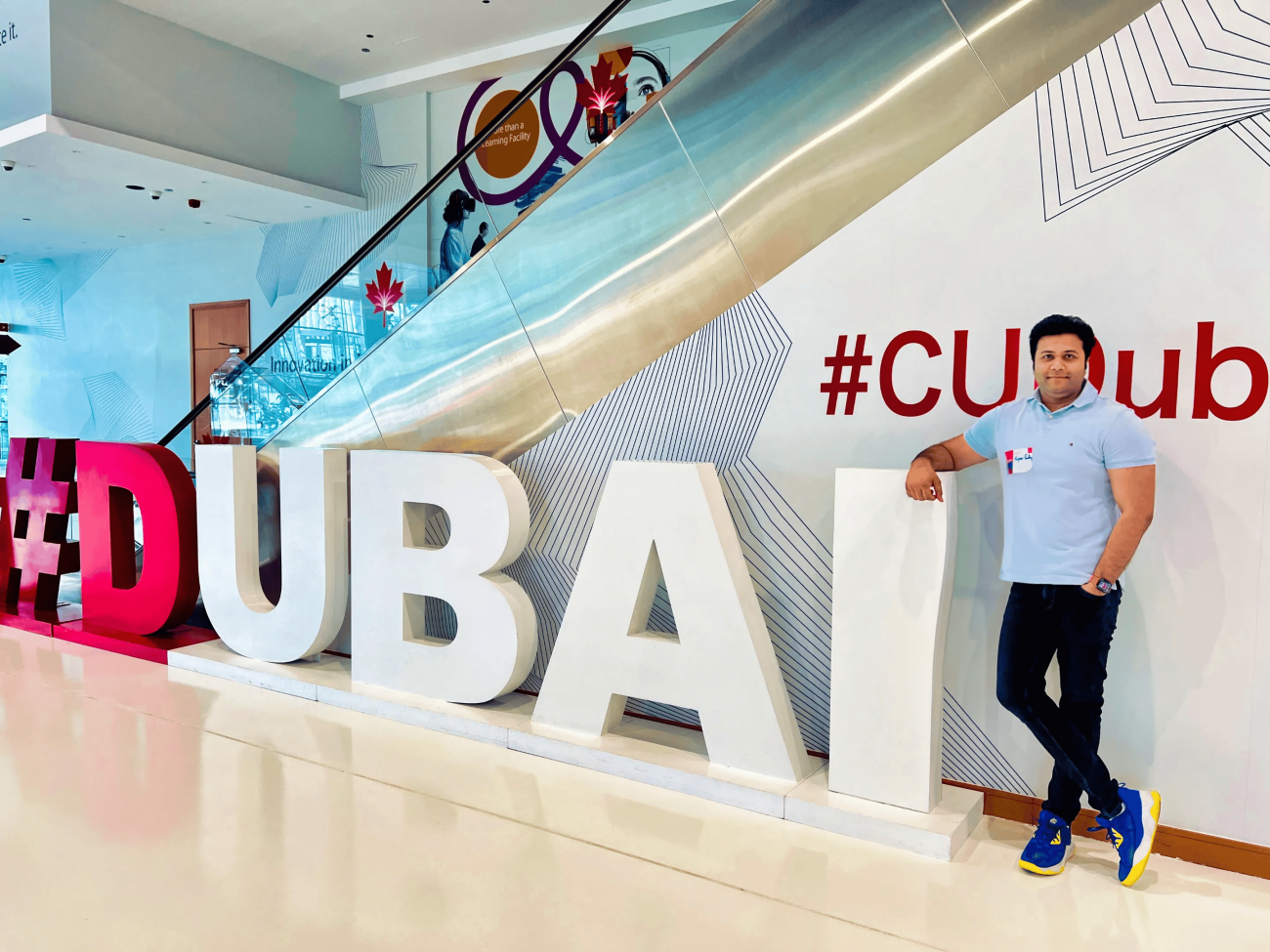
January 24, 2026, Dubai, United Arab Emirates (UAE): My professional compass has always pointed toward data. For over a decade, I have navigated my career through spreadsheets and databases, structures that quietly hold the entire story of what has already happened. I have built dashboards to make sense of the present and have spent long hours crafting forecasts that cautiously whisper about what might come next. My journey has wound through consultancy, healthcare, aviation, and banking, with each industry adding a new layer of understanding. These last 12 years have not just been about working with data, they have been about living inside it, moving from analyst to data visualisation specialist to data engineer. Every role deepened a kind of relationship with information.
But lately, during my evening drives down Sheikh Zayed Road, a different kind of question started to surface, one that felt less like a professional curiosity and more like a personal calling.
What if my role was not just to predict the future, but to actually help build it?
This question became a quiet obsession earlier this year, taking concrete form when I was entrusted to lead two of the most ambitious projects for my team at EmiratesNBD Bank. The first was to create a financial chatbot that could truly understand and assist our clients, drawing from our rich history of data. The second was to build a system that could analyze our competitors not as a static report, but as a living, breathing source of strategic insight. Day after day, I’d sit with my team, whiteboards filled with flowcharts, debating how to make these systems feel less like machines and more like partners. It was thrilling, daunting work. We weren’t just moving numbers around, we were trying to build a new kind of conversation between the bank and its competitors. And in those long, focused afternoons, a quiet realisation settled over me : my deep experience in data visualisaltion and data engineering were the bedrock, but the soul of what we were trying to create — the intuition, the anticipation — lived in the realm of artificial intelligence.
That realization was my turning point. It’s why I’m now walking away from the familiar path of another data science degree and stepping toward a Masters in Artificial Intelligence at Canadian University Dubai. For me, this isn’t just an academic preference. It’s a fundamental shift in mindset. Data has been my powerful rearview mirror for over a decade, showing me in perfect detail the road we have already traveled. But artificial intelligence feels like the headlights cutting through the fog ahead. It’s the compass for a journey we haven’t even named yet, the engine for a vehicle we are only just sketching, and a map for destinations we haven’t dreamed of. I am not just looking to analyse the past anymore but I want the tools to architect the future.
At EmiratesNBD Bank, change isn’t just a buzzword; it’s the air we breathe. The landscape of global finance reshapes itself daily. I have spent a year reporting on that change, but now I feel a deep pull to be in the room where it’s designed. My projects were a taste of that creative process. This master’s degree is my commitment to it. It’s about moving from the sidelines into the workshop, not just with enthusiasm, but with the formal, principled knowledge to build intelligently and responsibly. I want to ensure that the future we build for our C-suite executives at EmiratesNBD is not only revolutionary but also thoughtful, secure, and genuinely theirs.
Building A Future, Not Just Forecasting One
This decision is both deeply personal and strategically necessary. In modern banking, Artificial Intelligence is no longer a futuristic concept. It is the foundation of the next evolution. We have moved far beyond simple chatbots. This is about building adaptive risk models that learn and recalibrate in real time. It is about fraud detection systems that evolve faster than the threats they hunt. It is about creating client relationships that feel genuinely personal, yet operate at a scale that was once unimaginable.
Pursuing this masters degree is the bridge I am choosing to build. It is my intentional path from managing projects and people to originating intelligent systems and stewarding ethical innovation. My goal is to move from merely implementing the Artificial Intelligence tools created by others to understanding the very principles that make them work. I want to ensure these powerful systems are woven into the fabric of our financial ecosystem not just with intelligence, but with integrity.
Finding My Compass: Why Canadian University Dubai?
Finding the right program took time and reflection. I needed a curriculum that respected Artificial Intelligence as its own distinct discipline, a field of creation and cognitive engineering, not just an advanced elective in a data analytics syllabus. I found that clarity at Canadian University Dubai.
The promise of a Canadian educational framework was a major draw, offering a globally respected balance of deep theory and practical application. Canadian University Dubai’s standing as a top ranked private university in Dubai, consistently noted for academic rigor and graduate success, gave me real confidence. Their commitment to delivering a globally competitive Canadian education right here in Dubai, fully accredited by the United Arab Emirates Ministry of Education, meant I did not have to sacrifice my career or my life here to access a world class education.
Beyond the pedigree, it was the ecosystem that felt right. The modern campus, the palpable focus on innovation and research, and the clear connections to industry all signaled a place where theory meets practice. Most importantly, the schedule was built for someone like me, a working professional. This was not just a school rather it felt like the perfect environment for the kind of growth I was seeking.
I must pause here to offer my sincere thanks to Doctor Sahil Garg. From my first inquiry, his support and clear guidance through the entire admissions process have been invaluable. That kind of personalized attention, that genuine interest in a student’s journey, truly sets an institution apart.
The Practical First Step: Gathering The Documents
Before any dreams could take flight, there was the grounded, familiar work of gathering documents, a process anyone in the United Arab Emirates knows well. For fellow professionals in Dubai considering this path, here is what my application required.
First, proof of identity. I needed clear copies of my passport and my Emirates Identification Card.
Second, academic history. I provided official, attested transcripts from my previous university, which then needed to be attested by the United Arab Emirates Ministry of Education here in Dubai.
Third, English proficiency. I submitted my IELTS score report, supported by a letter from my previous university confirming English was the medium of instruction.
Fourth, financial documentation. I included a copy of my Fazaa card, which provides a valuable ten percent tuition discount for eligible applicants. This is a meaningful support for professionals investing in themselves.
Putting this package together was that first concrete step. It transformed a quiet ambition into a tangible process.
The Conversation That Mattered: The Assessment Interview
A defining moment in the application was the assessment interview. For thirty to forty five minutes, I spoke with two professors from the Artificial Intelligence department. This was not a grilling or a test but it was a thoughtful, two way conversation. They were not just checking boxes on a form. They were listening, trying to gauge my curiosity, my readiness, and whether this path was the right fit.
We talked about my foundation, my previous degree and my leadership experience at EmiratesNBD. They asked about my hands on skills, my practical knowledge of Python and Pandas, how I use SQL in my daily work. We discussed the language of Artificial Intelligence itself, touching on the mathematics and statistics that underpin it all. Finally, they presented a scenario, not for a correct answer, but to see how I would think through a real time business problem.
The purpose was clear and fair: to understand if I was prepared to dive into advanced modules or if I would benefit from preparatory courses. The conversation focused heavily on my applied experience and the live projects I am involved with at the bank. When it ended, I felt evaluated, certainly, but more than that I felt genuinely heard and understood.
The Email That Changed The Plan
The acceptance email arrived in the middle of a packed workday. I read it. Then I read it again. A mix of pride, a jolt of healthy nerves, and pure excitement washed over me. This was really happening.
My research had been thorough. I looked into other respected institutions in the United Arab Emirates like the pioneering Mohamed bin Zayed University of Artificial Intelligence in Abu Dhabi, the robust programs at Khalifa University, and the specialized offerings at University of Sharjah and Heriot Watt University Dubai. Each has incredible strengths. But in the end, it was Canadian University Dubai’s unique combination, Canadian academic rigor, a purpose built Artificial Intelligence curriculum, the flexibility of its Dubai location, and the human centered admissions process, that felt like the undeniable choice for my journey.
First Steps On Campus: More Than An Orientation
Orientation Day was less about formalities and more about immersion. After the initial welcome, we broke into small groups for a campus tour. The moment we entered the dedicated Artificial Intelligence Research Lab, the future became physical. Rows of high performance workstations hummed quietly. A lab technician showed us the newly installed Graphics Processing Unit clusters, the powerful engines that will drive our deep learning experiments. To have scheduled access to this kind of computational power for training complex models was a revelation; at the bank, this was still largely theoretical.
The tour led to a casual gathering in the student lounge, which became the heart of the day. This is where I met not just faculty, but my future community. I had coffee with a cybersecurity specialist from a major telecom who is integrating Artificial Intelligence for real time network threat detection. I spoke with a graduate student who had just published a paper on using neural networks to spot sophisticated financial fraud patterns. Their work was not academic fantasy; it was tangible research aimed at real problems here in the United Arab Emirates.
I was also paired with an Artificial Intelligence Buddy. My buddy, Hamid, is a data scientist at a leading Dubai logistics firm. Over a quick coffee, he shared how he is already applying computer vision models from his Canadian University Dubai coursework to optimize warehouse sorting. Sometimes the gap between the lecture and the office is just a weekend, he said with a smile. That was powerfully motivating.
Later, in a more intimate session, faculty members spoke not as distant lecturers, but as practitioners. One professor shared her consultancy work with a local financial technology startup on algorithmic fairness.
Another professor brought the theory to life by sharing his personal experience from the front lines of cybersecurity. He spoke about a specific time, earlier in his career, when he was part of a team responding to a sophisticated, multi-stage attack on a financial institution. Instead of abstract logs, he painted a picture of the tense, late-night hours in a security operations center. He explained how, in that critical moment, it was the machine learning models — models he had a hand in tuning — that first identified the subtle, anomalous pattern human analysts had missed. They weren’t just a line of code; they were the first alert, the crucial signal that bought the team precious time to mount a defense. In sharing that story, he showed us that artificial intelligence isn’t just a tool; in the right hands, it’s a partner and a protector.. Hearing that a student team had just won a regional hackathon for an ethical phishing detection tool they had built, that is when the potential of this place stopped being an idea and started feeling like a reality.
That first day did more than show me a campus. It showed me a living ecosystem. It revealed a community of tools, applied research, and most importantly, people, a network of professionals already building what they learn. My nervous excitement settled into a confident sense of anticipation. I was not just enrolling in a degree program. I was joining a mission.
The Real World Balancing Act: A Journey Shared
Let us be clear. Starting this masters is not a pause from my career. It is a deliberate and intensive acceleration of it.
The reality is a constant balancing act. It means showing up for the demanding leadership of my office journey. It means being truly present for my family. It means my amazing daughter Saalvi, who waits every single day to play after my office hours, my classes, my lectures, and my assignments. It means guarding my health and committing to the relentless pace of continuous learning.
I will be honest. It sounds overwhelming when you list it out. I know it will not be easy. Not even a little bit. But I also know, with a conviction that comes from deep down, that it will be worth it. This is not blind optimism. It is a choice. It is how I am choosing to build my path forward.
If you are reading this and standing at a similar crossroads, feeling that same pull toward the horizon of Artificial Intelligence, I would say this. Listen to that feeling. Lean into the hard questions. This journey is as much about rediscovering your own capacity to grow as it is about the technology.
I want this journey to be a shared one. I will be posting my learnings, challenges, and questions here regularly, and I genuinely hope to hear from those who have walked this path before me. If you are an industry expert, a practitioner, or someone further along in your Artificial Intelligence career, your guidance could make all the difference. I would be grateful for your insights, whether it is a piece of advice, a resource you found invaluable, or even a story about what you wish you had known when you started. Let us make this learning meaningful, together. I have always believed the most important things are built not in isolation, but together.
I am happy to learn together. Here is to building the road ahead.
Gallery