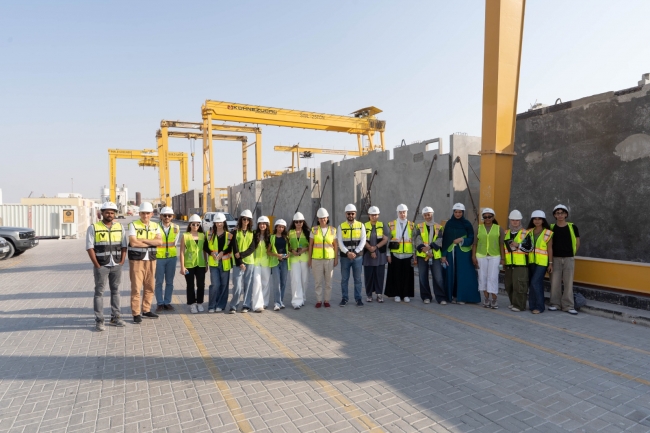
- CUD students are developing their own proposals for workspaces in public parks, using the completed Al Barsha Pond Park and Group AMANA's DuBox and DuPod facilities as their reference
- Group AMANA sits on the judging panel that will score the students’ final designs at the end of the semester
November 12, 2026, Dubai, United Arab Emirates (UAE: Dubai Municipality’s “Work from Park” initiative has become the reference project for a design assignment at Canadian University Dubai (CUD), where 25 interior design students from the School of Architecture and Interior Design are developing proposals to bring the initiative to more parks across the emirate.
Al Barsha Pond Park is the first flagship destination under Dubai Municipality’s Work from Park initiative, launched earlier this year to introduce flexible workspaces within public parks. The units were prefabricated off-site by Group AMANA through DuBox and DuPod, then installed at the park to minimise disruption for visitors.
Dr. Sana Tamzini, Assistant Professor at the school, initiated the assignment as a pedagogical research project. She chose Work from Park because it allows her students to follow a real project from concept to completion. The completed park shows how decisions on spatial planning, materials and user comfort have to respond to the realities of a public setting and a modular construction process.
Mohannad Al Omari, Business Development Manager at Group AMANA, joined the assignment’s judging panel for the students’ initial presentations. The panel will return at the end of the semester to score the final submissions on criteria including design, applicability and sustainability.
As part of the assignment, CUD students traced the project journey from the completed destination back to its manufacturing process. Following an earlier visit to Al Barsha Pond Park, the students and their faculty members toured Group AMANA’s DuBox and DuPod facilities in Dubai Industrial City.
The visit included a technical introduction to modular construction, guided walkthroughs of the manufacturing floor, and an insight into a large townhouse project currently in production.
Mohannad Al Omari said: “Work from Park demonstrates how modular construction can respond to the constraints of an active public environment by moving much of the build process away from site. This reduces disruption while maintaining closer control over quality and delivery timelines. As a reference project, it enables students to connect the finished destination with the manufacturing and assembly decisions behind it. On the judging panel, we value the questions students bring to the discussion, as fresh perspectives can challenge familiar assumptions and open up different ways of thinking about where the initiative goes next.”
Dr. Massimo Imparato, Dean of the School of Architecture and Interior Design at Canadian University Dubai, said: “Experiences like this are essential to architectural education because they allow students to see how ideas move from design thinking to real-world delivery. By engaging directly with Group AMANA’s modular manufacturing expertise, our students gain a valuable understanding of innovation, sustainability and the evolving methods shaping the future of the built environment.”
Rosemina Bidari, an interior design student at Canadian University Dubai, said: “Having representatives from Group AMANA on our judging panel was a valuable and encouraging experience. I was happy with how they appreciated my project, and their feedback gave me more confidence in my design and ideas. It was also a great opportunity to gain insights from industry professionals, which made working on a real project even more meaningful.”