Program Overview
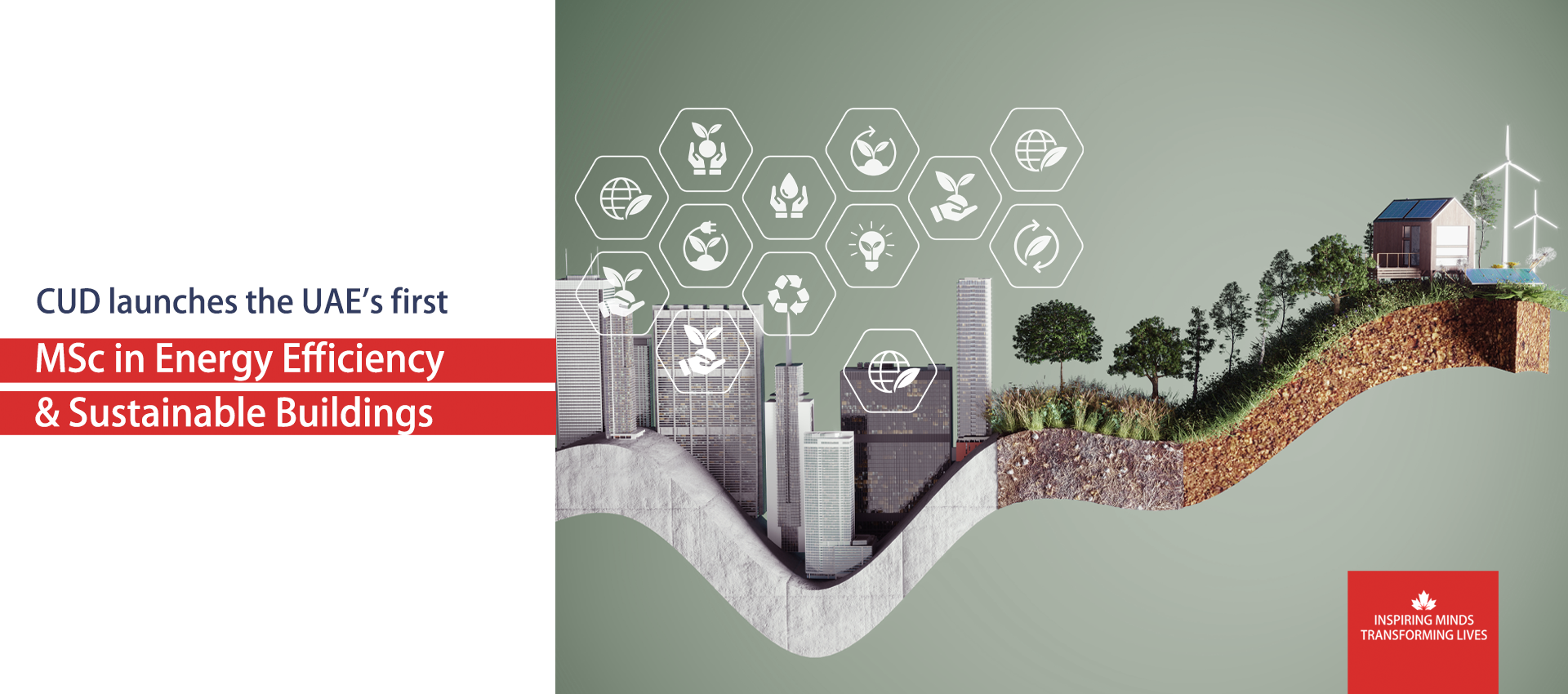
The Master of Science in Energy Efficiency and Sustainable Buildings (MScEESB) is an interdisciplinary graduate program designed to prepare professionals to lead the transformation of the built environment toward energy efficiency, climate responsiveness, and long-term sustainability. Through a curriculum grounded in engineering principles, environmental design, and innovative technologies, the program addresses both local and global sustainability challenges.
Benefits
The Master of Science in Energy Efficiency and Sustainable Buildings offers significant benefits, especially in today’s global shift toward sustainability and green construction. The program is designed to meet the high demand in the job market driven by the rapid growth of the global green building industry and the shift toward sustainable construction practices. Students will acquire the technical & practical skills needed to support the evolving industry. Furthermore, the curriculum and training are well aligned with both global Sustainability Goals and the UAE’s national sustainability vision, hence ensuring that graduates are well-prepared to pursue a career in sustainability and contribute to the development of climate-resilient, resource-efficient, and innovative built environments.
Graduates can work in architecture, engineering, energy consulting, policy making, and smart city development. In addition, specific opportunities for the UAE and the gulf region, particularly with Dubai’s Net Zero 2050 Strategy and Saudi Arabia’s NEOM project, experts in sustainable buildings are in high demand.
Graduates of this program emerge with highly sought-after expertise in sustainability, positioning them for impactful career opportunities across diverse industries. They are equipped to lead in roles that span engineering, design, consulting, policy, and innovation. Alumni often pursue careers such as:
- Engineers (Mechanical, Civil, Architectural) seeking sustainability expertise.
- Architects advancing green and net-zero building concepts.
- Energy Auditors & Consultants driving efficiency and resilience in the built environment.
- Policy makers & Urban planners focusing on smart cities.
- Building Energy Specialists (Energy modeler, Net-Zero energy consultants).
In addition, graduates are well-positioned to excel in specialized nicehs, including:
- HVAC & Indoor Air Quality (IAQ) engineering
- District Energy Planning & Build Automation
- Green materials & Circular economy consulting
- Sustainable construction & Project management
- Life cycle analysis & Cost assessment
- Green Building Certification (LEED, Estidama).
- Renewable energy integration & Sustainable infrastructure development
Equipped with skill set, graduates are not only job-ready but also but also future-ready, able to lead the global transition toward sustainable and resilient built environments. They may also pursue advanced studies, such as the PhD in Material Science, Energy Efficiency, or related fields, to deepen their expertise and strengthen their profile for careers in academic, research, and leadership, thereby broadening their professional opportunities.
The program has been awarded the accreditation by Ministry of Higher Education and Scientific Research, UAE on May, 17, 2025.
The graduates of the Master of Science in Energy Efficiency and Sustainable Buildings, within a few years of their graduation, will have:
- Goal 1: Established themselves as professionals that advance management of sustainable and energy-efficient building systems.
- Goal 2: Contributed to sustainable development initiatives and environmental responsibility at a practical levels, hence improving building performance and sustainable development practices.
- Goal 3: Engaged in continuous professional development through lifelong learning, advanced certifications, applied research, or further academic studies.
- Goal 4: Promoted the integration of advanced tools, innovation process, and interdisciplinary approaches to advance technologies and best practices in sustainable building systems.
- Goal 5: Made a positive societal and environmental impact by advancing climate-responsive, energy-efficient, and occupant-focused building solutions at local, regional, and global levels.
Upon successful completion of the Master of Science in Energy Efficiency and Sustainable Buildings program, the graduates of the program will be able to:
- PLO 1 Demonstrate good understanding of sustainable design, energy efficiency, , and thermal-fluid systems for high-performance building systems.
- PLO 2 Use advanced simulation tools and technologies to improve energy building performance and occupant comfort.
- PLO 3 Evaluate and integrate building systems for operational efficiency and occupant wellbeing.
- PLO 4 Critically evaluate and apply codes and rating systems for sustainable design compliance.
- PLO 5 Conduct innovative, ethical research using performance analysis tools to address practical challenges.
- PLO 6 Demonstrate leadership and entrepreneurship in managing sustainable projects and continuous learning.
- PLO 7 Communicate and justify sustainable solutions effectively to technical and non-technical audiences.
The MScEESB degree is offered at the CUD Campus as a full-time, regular study mode program. It is designed to be completed in three (3) semesters (equivalent to 1.5 academic year). The maximum duration for program completion is three academic years, providing flexibility for students who may need to extend their studies due to academic or professional reasons.
- Passed 30 credit hours.
- CGPA is not less than 3.0 on a scale of 4.0 points.
- Earned at least 75% of credits at CUD.
- Completed Thesis at CUD.
Dr. Seif Khiati
Associate Professor
Email: seif.khiati@cud.ac.ae
Phone: +971 4 709 6248
Office: HUB Sustainability Office
Program Structure
| Requirements | Compulsory
Credit Hours |
Elective
Credit Hours |
Total
Credit Hours |
|||
|---|---|---|---|---|---|---|
| Program Core Requirements (Core Courses) | 18 | - | 18 | |||
| Program Thesis | 6 | 6 | 12 | |||
| Total | 24 | 6 | 30 | |||
| Course Code | Course Title | Prerequisite | Credit Hours | |
|---|---|---|---|---|
| MES | 601 | Energy Performance in Buildings | None | 3 |
| MES | 602 | Thermal and Fluid Systems in Buildings | None | 3 |
| MES | 603 | Sustainable Materials for Efficient Buildings | None | 3 |
| MES | 604 | Sustainable Design Technologies for Building Performance | None | 3 |
| MES | 611 | Research & Development Project | MES 601, MES 602, MES 603 & MES 604 | 3 |
| MES | 612 | Sustainable Building Systems and Energy Optimization | MES 601 & MES 604 | 3 |
| MES | 700 | Thesis | MES 611 & MES 612 | 6 |
| Elective Courses (06 Credits): Students are required to select Two Courses from the following Pool: | ||||
| MES | 631 | International and UAE Regulations and Building Labelling | MES 601, MES 604 | 3 |
| MES | 632 | Information Technology Applications in Building Engineering | MES 604 | 3 |
| MES | 633 | Acoustics of Building Equipment | MES 602, MES 603 | 3 |
| MES | 634 | Construction Management and Cost Estimation | MES 603, MES 604 | 3 |