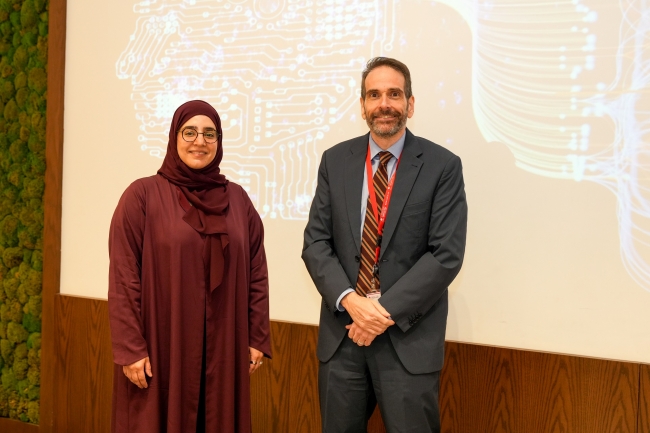
August 8, 2026, Dubai, United Arab Emirates (UAE): Doctor of Business Administration (DBA) candidates at Canadian University Dubai explored doctoral research practice and the strategic applications of big data during an industry expert session led by Dr. Sarah Talib, Industry Expert in Big Data Analytics Capabilities.
Held as part of DBA 706, Seminar on Business Strategies and Sustainability, the session brought together doctoral development, research practice, and contemporary applications of Big Data Analytics Capabilities. Through two connected learning components, candidates considered both the intellectual demands of doctoral study and the organizational capabilities required to transform data into meaningful business value.
From Curiosity to Contribution
The first component, titled “From Curiosity to Contribution,” drew on Dr. Sarah’s own doctoral experience to offer candidates a practical perspective on the doctoral journey.
The discussion moved beyond the formal stages of reading, collecting data, and writing a thesis to examine the deeper process of learning to question assumptions, think critically, manage uncertainty, and make an original and defensible contribution.
Candidates were encouraged to approach research as an iterative process of questioning, reading, revising, discovering, and rewriting. The session also highlighted the importance of moving beyond summarizing existing literature toward comparing evidence, synthesizing knowledge, and developing evidence-based arguments.
The responsible use of artificial intelligence in doctoral research was another important theme. While AI can support activities such as discovery, summarization, classification, and draft refinement, candidates were reminded that researchers must retain ownership of the research question, evidence, theory, judgment, interpretation, and contribution.
Big Data Analytics Capabilities
The second component focused on Big Data Analytics Capabilities and how organizations can move beyond simply possessing data and technology. Candidates examined definitions and sources of big data, the progression from descriptive and diagnostic analytics to predictive and prescriptive approaches, and the role of governance, organizational learning, leadership, and a data-driven culture in effective decision-making.
A central takeaway was that technology alone does not constitute an analytics capability. Creating organizational value requires the effective combination of data and technological resources, technical and managerial skills, and intangible capabilities such as organizational learning and a data-driven culture. These resources must be supported by appropriate governance, decision rights, organizational structures, and leadership sponsorship.
The discussion also identified promising avenues for doctoral research, including how organizations develop and reconfigure analytics capabilities, how analytics influences strategic decision-making, and how data readiness shapes the value that can be generated from artificial intelligence.
Three practical scenarios involving a regional hospital, a public library network, and a corporate human resources department helped candidates consider how different organizations generate, manage, and derive value from data. The applied discussion encouraged candidates to connect theory with practice, use frameworks purposefully, and make evidence-based strategic judgments.
Reflecting on the session, Dr. Sarah Talib said: “Engaging with CUD’s DBA candidates was insightful and inspiring.”
The session reflects CUD’s commitment to connecting advanced academic study with contemporary managerial practice. By engaging with current research challenges and real organizational scenarios, DBA candidates had the opportunity to strengthen the critical, analytical, and strategic capabilities required to contribute to scholarship and professional practice.