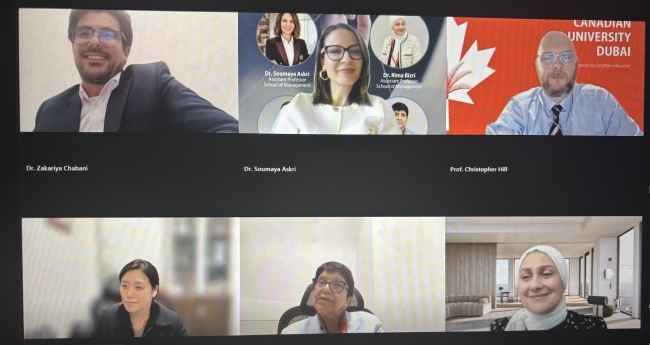
May 21, 2026, Dubai, United Arab Emirates (UAE): As intelligent systems continue to reshape industries, redefine jobs, and transform the future of work, the Canadian University Dubai (CUD) School of Management (SOM) recently hosted a panel discussion exploring the human capabilities that will define success in an era of intelligent systems.
Titled The Human Edge: Core Capabilities for Value Creation in the Age of Intelligent Systems, the online event brought together faculty experts from SOM to discuss the skills, mindsets, and leadership qualities required to thrive alongside increasingly intelligent systems. The panel featured SOM faculty members Dr. Soumaya Askri, Assistant Professor; Dr. Rima Bizri, Associate Professor; Dr. Ji Yeh Choi, Associate Professor; and Dr. Kiran Tangri, Assistant Professor.
Through an engaging exchange of perspectives, panelists examined how universities, organizations, and individuals can prepare for a future where technological capability and human judgment must increasingly work together. The discussion was inspired by the growing recognition that the future of work, education, and leadership is undergoing profound transformation, both in the UAE and globally.
The session highlighted the importance of preparing students and professionals not for a distant future, but for a reality that is already unfolding. As intelligent systems reshape industries and workforce expectations, graduates must be equipped to remain relevant, resilient, and impactful while contributing meaningfully to organizations and society.
Throughout the discussion, panelists explored the growing importance of strategic thinking, human judgment, creativity and innovation, adaptability and resilience, ethical decision-making, data-informed reasoning, leadership and collaboration, and entrepreneurial thinking. While intelligent systems continue to transform how organizations operate, the discussion emphasized the enduring value of human-centered capabilities in navigating complexity, driving innovation, and supporting responsible decision-making.
A key theme was the changing nature of employability itself. As industries evolve and professional roles continue to shift, panelists discussed the growing importance of adaptability, collaboration, problem-solving, and sound judgment alongside technological understanding. The discussion also highlighted a broader shift from credentials-based thinking toward capabilities-based thinking, where demonstrated skills, agility, and the ability to solve real-world challenges are becoming increasingly important.
Panelists also reflected on the need to strengthen the connection between education and hands-on application, ensuring graduates are prepared not only for today’s roles, but also for opportunities and challenges that may not yet fully exist. Lifelong learning was identified as essential in an era of rapid technological change, with adaptability and continuous capability development seen as foundations for long-term success.
Another important insight centered on the enduring value of human-centered capabilities. As intelligent systems become increasingly capable of supporting technical and analytical tasks, qualities such as ethical judgment, emotional intelligence, creativity, communication, and leadership will become even more important. The discussion emphasized that while technology can enhance efficiency and provide valuable insights, human judgment remains essential in determining how technology is applied responsibly, ethically, and effectively.
The panelists also highlighted the importance of preparing future professionals not simply to use technology, but to apply it meaningfully and creatively to solve real-world challenges. The future workforce advantage, they noted, will belong to individuals who can combine technological understanding with strong human capabilities, interdisciplinary thinking, and a commitment to responsible innovation.
The discussion reflected SOM’s broader commitment to preparing students not only for employment, but for long-term relevance and leadership in rapidly evolving industries. Through a focus on innovation, critical thinking, ethical leadership, adaptability, and industry engagement, SOM continues to equip graduates with the knowledge, skills, and mindset required to navigate uncertainty and contribute meaningfully to organizations and society.
The themes explored throughout the session also align closely with the UAE’s broader national vision of building a skills-driven, innovation-oriented economy where lifelong learning, agility, and talent development are strategic priorities.
Reflecting on the importance of human-centered capabilities in an increasingly intelligent world, Dr. Soumaya Askri said:
"In the age of intelligent systems, competitive advantage will no longer come from technical knowledge alone. It will come from uniquely human capabilities, adaptability, emotional intelligence, ethical judgment, creativity, and critical thinking that enable people to lead, innovate, and create meaningful value alongside AI."
As intelligent systems continue to evolve, the discussion reinforced a central message: the future belongs not to those who simply adopt new technologies, but to those who can combine technological capability with human judgment, creativity, adaptability, and ethical leadership to create meaningful and sustainable value.